-
MODULE 1: English Language Learners in Arizona
44 Lessons-
StartMODULE 1, LESSON 1 - Legal and Historical Foundations
-
Start1.1a - Legal Foundations
-
Start1.1b-1 - Defining English Learners (1)
-
Start1.1b-2 - Defining English Learners (2)
-
Start1.1c-1 - History of Federal Law and Policy Related to Multilingual Learners
-
Start1.1c-2 - Federal Law: Bilingual Education Act
-
Start1.1c-3 - Federal Law: Lau v Nichols
-
Start1.1c-4 - Federal Law: EEOA and Castaneda v Pickard
-
Start1.1c-5 - Federal Law: Plyler v Doe
-
Start1.1c-6 - Federal Law: NCLB and ESSA
-
Start1.1d - QUIZ: Check Understanding: Federal Law and Policy
-
Start1.1e - The Arizona Context
-
Start1.1f - QUIZ: Check Understanding: The Arizona Context
-
StartMODULE 1, LESSON 2: Define and Discuss Arizona’s Language Development Approach (LDA)
-
Start1.2a - Check Understanding: Discussion and Quiz - Arizona's Language Development Approach
-
StartMODULE 1, LESSON 3: Principles 1 and 4 of Arizona's LDA
-
Start1.3a - Check Understanding: Discussion: Principles 1 and 4 of Arizona's LDA
-
StartMODULE 1, LESSON 4: Principles 2 and 3: Targeted and Integrated Instruction
-
Start1.4a - Check Understanding: Discussion: Principles 2 and 3: Targeted and Integrated Instruction
-
StartMODULE 1, LESSON 5: Synthesis of the Research on English Learners
-
Start1.5a - Grounding
-
Start1.5b - Arizona's Language Development Approach
-
Start1.5c - Principle 1 - Asset-Based Behaviors and Expectations
-
Start1.5d - Principle 1 - Asset Based Behaviors and Expectations: The Research
-
Start1.5e - Principle 2 - Integrated SEI Instruction in Disciplinary Language and Content
-
Start1.5f - Principle 3 - Targeted ELD and Explicit Language Instruction
-
Start1.5g - Principle 4 - Assessment, Feedback, and Progress Monitoring
-
Start1.5h-1 - Check Understanding: Synthesis of Research
-
Start1.5h-2 - Check Understanding: Synthesis of Research - Notecatcher
-
StartMODULE 1, LESSON 6: Arizona's SEI Models and Placement of ELs
-
Start1.6a - Grounding
-
Start1.6b - 1 SEI Definitions
-
Start1.6b - 2 QUIZ: Check Understanding: SEI Definitions
-
Start1.6c-1 Arizona's SEI Models
-
Start1.6c-2 QUIZ: Check Understanding: Arizona's SEI Models
-
Start1.6d - Eligibility, Program Placement, and Assessment Accommodations
-
Start1.6e-1 Diversity of English Learners: Dually Identified Students
-
Start1.6e-2 Check Understanding: Gifted and ELL
-
Start1.6f - Diversity of English Learners: LTEL, RAEL, SIFE, Migrant, Refugee, and Native American Students
-
Start1.6g - QUIZ: Arizona's SEI Models and Placement of ELs
-
Start1.6g-2 - Check Understanding: Arizona SEI Models and Placement of ELs
-
Start1.6g-3 - Check Understanding: Arizona SEI Models and Placement of ELs
-
StartMODULE 1, LESSON 7: English Learners in my community, school, district, city and state
-
Start1.7a - Check Understanding: Discussion - English Learners in my community, school, district, city, state
-
-
MODULE 2: Understanding Language Development
40 Lessons-
StartMODULE 2, LESSON 1: Language Acquisition Theories
-
Start2.1a - Grounding
-
Start2.1b - First Language Acquisition
-
Start2.1c - Developmental Milestones
-
Start2.1d - Second Language Learning: Learning vs. Acquisition
-
Start2.1e - Theories of Second Language Acquisition
-
Start2.1f - Connecting Language Acquisition Theory to the LDA
-
Start2.1g - QUIZ: Check Understanding: Language Acquisition Theories
-
StartMODULE 2, LESSON 2: Foundations of Language Part 1
-
Start2.2a - Check Understanding: Discussion: Foundations of Language, Part 1
-
StartMODULE 2, LESSON 3: Arizona's English Language Proficiency Standards (ELPS)
-
Start2.3a - Check Understanding: Upload ELPS Guided Notes
-
Start2.3b - Check Understanding: Discussion: English language Proficiency Standards (ELPS)
-
StartMODULE 2, LESSON 4: ELPS Deep Dive
-
Start2.4a - QUIZ: Check Understanding: English Language Proficiency Standards (ELPS)
-
StartMODULE 2, LESSON 5: Lesson Planning for Targeted ELD
-
Start2.5a - Grounding
-
Start2.5b-1 Key Components for Targeted Instruction
-
Start2.5b-2 QUIZ: Check Understanding: Key Components of Targeted ELD
-
Start2.5c-1 Targeted Instruction in Action
-
Start2.5c-2 Check Understanding: Lesson Planning for Targeted ELD
-
Start2.5c-3 Check Understanding - UPLOAD: Guided Notes on Targeted Instruction
-
StartMODULE 2, LESSON 6: Lesson Planning for Integrated ELD
-
Start2.6a - QUIZ: Check Understanding: Key components of Integrated ELD Instruction
-
Start2.6b - Grounding: Moises in Math Class
-
Start2.6c - Integrated ELD versus Targeted ELD
-
Start2.6d - Incorporating key components of Integrated ELD
-
Start2.6e-1 Using the ELPS to Develop Language Objectives
-
Start2.6e-2 Step 1: Identify Content Objective
-
Start2.6e-3 Step 2: Language Demands
-
Start2.6e-4 Step 3: Identify ELP Standard & Performance Indicator
-
Start2.6e-5 Step 4: Write and Differentiate Language Objective
-
Start2.6e-6 Selecting Standards and Differentiation
-
Start2.6f - Tiered Vocabulary
-
Start2.6g - Rigor through Intentional Scaffolds
-
Start2.6h-1 Putting It All Together
-
Start2.6h-2 Check Understanding: Putting It All Together
-
Preview2.6z - SEI Lesson Planning Tool
-
StartMODULE 2, LESSON 7: Collaborative Lesson Planning for Targeted and Integrated ELD
-
Start2.7a - Assignment: Targeted and Integrated Lesson Plan: Draft 1
-
-
MODULE 3: Instructional Practices for English Learner Success
66 Lessons-
StartMODULE 3, LESSON 1: Foundations of Language, Part 2: Reading
-
Start3.1a - Grounding
-
Start3.1b-1 Science of Reading Research - Overview
-
Start3.1b-2 Science of Reading: Simple View
-
Start3.1b-3 Science of Reading: Scarborough's Rope
-
Start3.1b-4 Science of Reading: Four-Part Processing Model
-
Start3.1c-1 The Five Features of Effective Reading Instruction
-
Start3.1c-2 The Five Features of Effective Reading Instruction: Structured Literacy
-
Start3.1c-3 The Five Features of Effective Reading Instruction: Explicit Instruction
-
Start3.1c-4 The Five Features of Effective Reading Instruction: Systematic Instruction
-
Start3.1c-5 The Five Features of Effective Reading Instruction: Cumulative Instruction
-
Start3.1c-6 The Five Features of Effective Reading Instruction: Diagnostic and Responsive Assessment
-
Start3.1c-7 Check Understanding - Five Features of Effective Reading Instruction: Affirmative and Corrective Feedback
-
Start3.1d-1 Science of Reading and Multilingual Learners
-
Start3.1d-2 Science of Reading for MLLs: The Bilingual Reading Brain
-
Start3.1d-3a Science of Reading for MLLs: Classroom Strategies and Examples
-
Start3.1d-3b Check Understanding: Science of Reading for MLLs: Classroom Strategies
-
Start3.1d-4 Science of Reading for MLLs: Making Cross-Linguistic Connections
-
Start3.1d-5 Science of Reading for MLLs: Responding to MLs needs - Focus on linguistic assets
-
Start3.1e - Stages of Second Language Acquisition and Writing Development
-
Start3.1f - MTSS and RTI for English Learners
-
Start3.1g - Summary: Putting It All Together
-
Start3.1h - Check Understanding - Foundations of Language Part 2
-
StartMODULE 3, LESSON 2: Asset Based Behaviors and Expectations
-
Start3.2a - Check Understanding - Discussion: Asset Based Behaviors and Expectations
-
StartMODULE 3, LESSON 3: Home-School Connection
-
Start3.3a - Check Understanding - Discussion: Home-School Connections
-
StartMODULE 3, LESSON 4: Instruction Aligned to ELPS Standards 1 thru 5
-
Start3.4a - Grounding
-
Start3.4b-1 ELPS Standards 1 and 2
-
Start3.4b-2a ELPS Standards 1 and 2: Deep Dive Standards 1 and 2
-
Start3.4b-2b Check Understanding: ELPS Standards 1 and 2: Deep Dive Standard 1 and 2
-
Start3.4c - Comprehension Skills and Strategies for Secondary English Learners
-
Start3.4d - ELPS Standards 3 to 5
-
Start3.4e - Supporting Speaking Development
-
Start3.4f - Supporting Writing Development
-
Start3.4g - Putting It All Together
-
Start3.4z - Check Understanding - ELPS Standards 1-5
-
StartMODULE 3, LESSON 5: Instruction Aligned to ELPS 6-10- ASYNCH
-
Start3.5a - Grounding
-
Start3.5b - ELPS Standards 6 to 8: Deep Dive
-
Start3.5c - ELPS Standards 9 and 10
-
Start3.5d - ELPS Standard 9
-
Start3.5e - ELPS Standard 10
-
Start3.5f - Vocabulary Strategies
-
Start3.5g - ACTION: Revise Lesson Plans from 2.7
-
Start3.5z - Check Understanding - Instruction Aligned to ELPS 6-10
-
StartMODULE 3, LESSON 6: Assessment, Monitoring, and Feedback
-
Start3.6a - Grounding
-
Start3.6b-1 Different Types of Assessment: What, When, How and Why
-
Start3.6b-2 Screening Assessments
-
Start3.6b-3 Diagnostic Assessments
-
Start3.6b-4 Formative Assessments
-
Start3.6b-5 Summative Assessments
-
Start3.6c-1 Designing Aligned Classroom Assessments
-
Start3.6c-2 Connecting the Dots
-
Start3.6c-3 Practice and Reflect
-
Start3.6d-1 Planning for Intentional Feedback
-
Start3.6d-2 Planning for Intentional Feedback - Pt. 2
-
Start3.6d-3 ACTION: Revisit Lesson Plans from 2.7
-
Start3.6e - Student Reflection and Goal-Setting
-
Start3.6z - Check Understanding - Assessment, Monitoring, and Feedback
-
StartMODULE 3, LESSON 7: Create Final Targeted and Integrated Lesson Plans
-
Start3.7z - Check Understanding - Final Project: Targeted and Integrated Lesson Plan
-
StartMODULE 3, LESSON 8: Final Project Presentations, Survey, and Next Steps
-
Start3.8z - Exit Ticket - Upload Video: Final Project Presentation and Next Steps
-
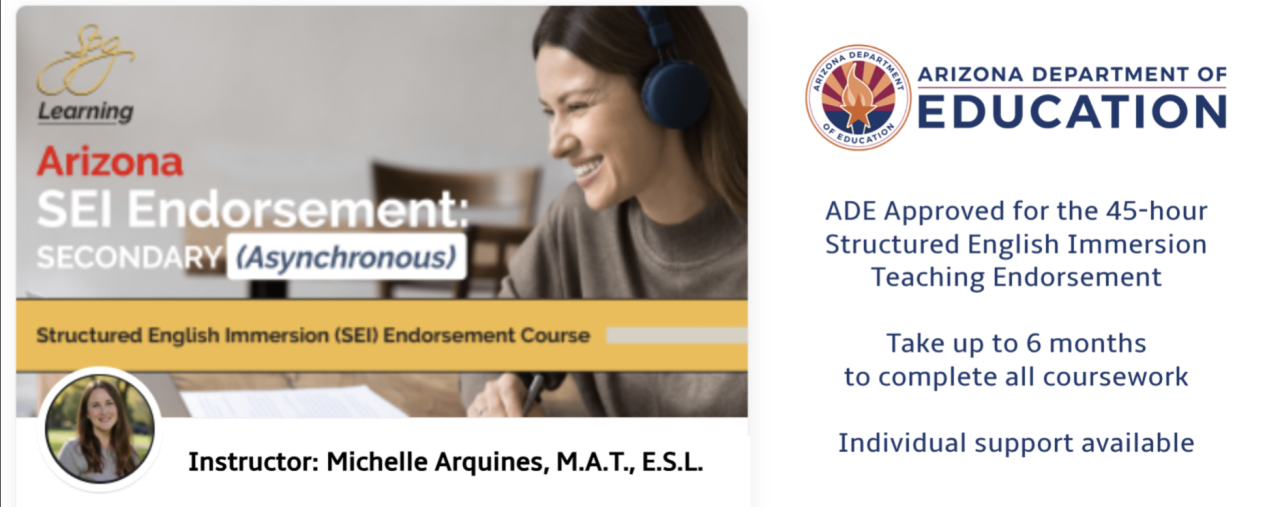
Arizona SEI Endorsement: Secondary Asynchronous
Earn the SEI Endorsement to add to your professional teaching certificate. 45-hour asynchronous course; take up to 6 months to complete.
Course Summary
Welcome to the Arizona Structured English Immersion (SEI) - Secondary Course!
The purpose of this course is to prepare Arizona teachers with the knowledge and skills to effectively provide Integrated Structured English Immersion instruction as designated in any of the four approved SEI models in the state of Arizona.
This course is self-paced and is designed to take 45 hours to complete. You will have up to 6 months to complete the content in this course. All course content can be accessed using the Modules tab on the left hand side of the screen.
The course has three overarching goals:
- To help teachers effectively carry out their responsibility for the teaching and learning of ELs as well as to understand the social and cultural issues that contribute to and impact the schooling of ELs.
- To expand teachers’ knowledge of how language functions within academic content teaching and learning, and how children and adolescents acquire a second language.
- To provide teachers with practical, research-based methods, and strategies to integrate subject-area content, language, and literacy development, thereby preparing students to meet the expectations of the AZELLA assessment, the Arizona English Language Proficiency Standards (ELPs) and the Arizona State Standards.
Course Curriculum

Michelle Arquines
Michelle has over 20 years experience in multilingual and multicultural education. She has served as elementary teacher, ESL Department Chair, and School-Based Teacher Leader in several school districts. She has also served as an Instructional Coach for Multilingual Learning with large publishing houses. She is currently a Project Manager and Editor for SPG-produced curriculum in English and Spanish.
Michelle has a Bachelor of Arts (BA) in History from the College of Arts and Sciences and a Master of Arts in Teaching (MAT) in Education from the School of Education at American University in Washington, DC.
"I did not know anything about the Arizona Education's Laws. This course helped me to understand them. This course has important information about teaching that I can use to better prepare my classes. "
Course Pricing
Arizona SEI Endorsement: Secondary Asynchronous
$285 USD
-
Arizona SEI Endorsement: Secondary Asynchronous